Aquarium Heater UK Wattage: What Size for a 600 Litre Tank?
TL;DR: Size an aquarium heater at roughly 1 watt per litre in a centrally heated UK room: a 600 litre tank needs 600W as a baseline, or 750W if the room drops below 16°C at night. Above 500 litres, most keepers are better served by two 500W elements on one external controller than a single large heater — you get even heat distribution and a built-in backup.
Aquarium heater UK wattage questions come up constantly from keepers who have just collected a second-hand 600 litre tank from Facebook Marketplace: the lights and filter work, but the heater is missing, ancient, or simply not trusted. Forum answers pull in opposite directions — some swear by 1W per litre, others insist you must run two heaters — and the high-street shop rarely stocks anything much above 300W. This guide settles the wattage question with a sizing table that actually goes up to 900 litres, then covers placement, summer overheating and when a precision controller earns its place.
Why Does Heater Wattage Matter?
A heater must raise your tank from the coolest ambient temperature it will experience to your target tropical range (typically 24–26°C for community fish). In a UK home with central heating, room temperature usually sits at 18–21°C in winter. However, unheated rooms, conservatories, and garages can drop to 15°C or below overnight.
An undersized heater runs constantly, struggles to hold temperature, and wears out faster. An oversized single element cycles on and off rapidly, creating hot spots near the tube. The goal is a heater that warms the tank steadily without running at 100% duty cycle — typically reaching target temperature in 30–60 minutes from a cold start, then maintaining with short intermittent cycles. On a large tank, wattage split across two elements achieves this more smoothly than one big tube at a single point.
The 1 Watt Per Litre Rule (UK Sizing Table)
The simplest sizing method for UK aquarists: 1W per litre of water (equivalent to approximately 5W per US gallon). In practice this holds up well for tanks in heated rooms across typical UK homes.
| Tank Volume | Recommended Heater | Typical UK Use Case |
|---|---|---|
| 30 litres | 25–50W | Nano betta or shrimp tank |
| 60 litres | 50–75W | Beginner community (see our best tropical fish for a 60L tank UK guide) |
| 100 litres | 100W | Standard community aquarium |
| 200 litres | 200W | Large community or cichlid setup |
| 500 litres | 500W (or 2 × 300W) | Big community, Malawi cichlids |
| 600 litres | 600–750W (ideally 2 elements) | Second-hand 6ft display tanks |
| 700–800 litres | 800W (1 × 800W or 2 × 500W) | Discus, large planted displays |
| 900 litres | 2 × 500W on one controller | Arowana, stingray, big marine systems |
If your tank sits in a cold room (below 16°C at night), size up by 25%. Conversely, if the tank is in a warm living room that rarely drops below 20°C, you may size down slightly — but never go below 0.7W per litre for tropical species.
One 1000W Element or Two 500W? The Second-Hand Big Tank Question
This is the question that stalls most new owners of big second-hand tanks, and the forum contradiction is real because both camps are half right. A single 1000W element is simpler and heats fast. Two 500W elements — one at each end, run from a single external controller — heat the water column more evenly, avoid a single hot spot behind the rockwork, and mean that if one element fails on a January night, the other keeps the tank out of the danger zone until you notice.
For anything from 600 litres up, the two-element layout is the safer configuration, The XINDI XD-L880 on this site is one 500W quartz rod, listed for tanks up to 300 L.
A note on household electrics, since this worries many first-time big-tank owners: a 1000W heater draws a little over 4 amps at UK mains voltage — well within a standard 13A socket's rating. Plug heaters directly into a wall socket or a surge-protected strip rated for the load, keep a drip loop in the cable, and avoid daisy-chained extension leads.
UK Summer Heat: When Your Tank Runs Too Hot
British heatwaves are increasingly common, and UK fishkeepers frequently report tank temperatures climbing to 28–30°C without any heater input. When ambient room temperature exceeds your target tank temperature, the heater should not activate at all — but poor insulation and direct sunlight can push temperatures dangerously high.
Practical UK summer tips:
- Move tanks away from south-facing windows and radiators.
- Increase surface agitation (filter output or air stone) to boost evaporative cooling.
- Float frozen water bottles in the tank during extreme spikes (emergency only).
- Use a heater with a wide temperature range and reliable thermostat that stops heating above set point — not all budget heaters do this consistently.
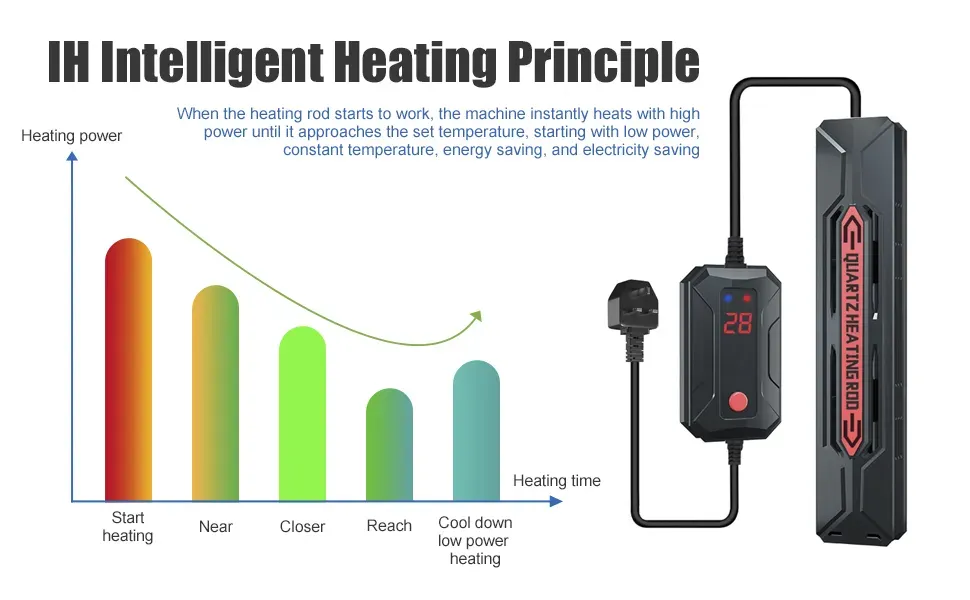
For large systems where temperature stability is critical, an external digital controller with a separate temperature probe — rather than relying solely on the built-in thermostat — provides an extra safety layer. Our XINDI XD-L880 500W quartz heater uses an external single LED display. Set 20–34 °C. It is listed for tanks up to 300 L, or about 100 cm long.
Glass vs Titanium Heaters: What UK Buyers Should Know
Most small UK tanks (under 200L) use glass-sheathed heaters costing £10–£25. They work adequately for community setups when paired with a separate thermometer for verification. However, glass heaters have known failure modes: cracking during water changes if exposed to air while hot, and seal degradation over time. If your tank arrived second-hand, treat any bundled heater as unknown history — thermostats and seals degrade invisibly, and the heater is the one piece of used equipment most worth replacing new.
Titanium heaters cost more but offer significant advantages for larger or high-value setups:
- Shatterproof: Titanium elements survive accidental exposure during maintenance.
- Dry-run protection: Quality systems cut power if the element leaves water.
The XINDI XD-L880 sold here is a quartz heater, not titanium. It has an external single LED display and a power cable about 190 cm, with the set button in the middle of the cable. Keep that button dry.
Heater electricity is the largest ongoing cost for tropical UK tanks, and correct wattage sizing (plus cabinet insulation) is what keeps the duty cycle — and the bill — down. For worked kWh examples by tank size at current rates, see our guide to fish tank heater electricity costs.
Installation Tips for UK Homes
- Position near filter flow so warmed water circulates evenly. Never place the heater in a dead corner.
- Submerge fully before plugging in. Wait 15 minutes after installation before switching on to allow the thermostat to acclimatise.
- Use a separate thermometer to verify heater accuracy monthly. Digital stick-on thermometers are adequate for community tanks.
- For larger tanks, match wattage to volume and keep a spare heater — if one fails, the tank still has heat.
- Plan the rest of the kit around the heater. Our guide on how to start a home aquarium UK covers the full equipment checklist, including which second-hand items to replace.
Frequently Asked Questions
What size heater do I need for a 600 litre aquarium?
Budget 600W as a baseline in a centrally heated UK room, or around 750W if the room falls below 16°C overnight. The most robust way to deliver that power is two heaters, positioned at opposite ends of the tank.
What size aquarium heater do I need for a 60-litre tank in the UK?
A 50–75W heater is ideal for a 60-litre tropical tank in a standard UK heated home. If the tank sits in a cold room or unheated space, choose 75W. Match your heater to the fish species in our 60L tropical fish guide.
Is 5 watts per gallon accurate for aquarium heaters?
It is a reasonable starting point (roughly 1W per litre). However, room temperature matters significantly in UK homes. Cold rooms need more wattage; warm, stable rooms can use slightly less. Always monitor with a thermometer rather than relying on rules alone.
When should I upgrade to a precision heater system?
Consider a precision system with an external controller when your tank exceeds 200 litres, houses high-value livestock, or requires redundancy (multiple heating elements on one controller). For UK home tanks, our XINDI XD-L880 500W quartz heater (£54.02 inc. VAT, free UK delivery) is a 500W quartz rod with dry-run protection in the upper half of the tube.
Shop precision heating: XINDI XD-L880 500W quartz heater — £54.02 inc. VAT, free UK delivery
Ready to try AquariumPet?